
WAITKUS, an item pluspartner, uses a combination of autonomous mobile robots (AMRs) and low-cost intelligent automation (LCIA) to help ensure an efficient, ergonomic and transparent flow of materials.
Bottlenecks and waiting times in production environments can often be attributed to the manual movement of materials. Heavy loads, long distances from A to B and interrupted workflows all lead to lengthy throughput times and put a lot of physical strain on staff. In a recent project, WAITKUS Engineering GmbH – an item pluspartner specialising in sustainable Karakuri/LCA solutions and intralogistics automation – has shown how to make material flows far more efficient, ergonomic and transparent thanks to a combination of automation, mechanics and modular design.
WAITKUS and item – a long-standing partnership for low-cost automation
WAITKUS is a full-scope innovation partner with an extensive range of services, including everything from mechanical engineering, software development, electrical engineering, die making and sustainable LCA solutions through to intralogistics automation and additive manufacturing for high-quality products. The company offers development and design engineering services for a wide range of different sectors and industries.
Line D30 and Line 8 aluminium profiles were used in this project, along with roller conveyors and door components.
WAITKUS and item have been working together since 2016. WAITKUS specialises in driverless transport systems and Karakuri solutions. As a member of the item pluspartner network, the company pools its expertise with other item pluspartners in order to implement innovative joint projects. WAITKUS uses the full range of item profile technology. “In our partnership with item, the trust is simply there,” says the company’s owner Franz Waitkus. In this latest project, for instance, WAITKUS has used Line D30 and Line 8 profiles as well as roller conveyors and door components.
Fully automated flow of goods at Magnetbau Schramme
Magnetbau Schramme GmbH & Co. KG develops electromagnetic actuators worldwide. Its production operations were previously dominated by manual activities, with goods carriers that weighed up to 22 kg being moved about on a daily basis by staff working a two-shift pattern. Quite apart from the substantial manpower requirements, transporting goods in this way also caused a great deal of physical and mental strain.
To make the process of transporting goods more efficient and ergonomic, a solution combining state-of-the-art automation technology and Karakuri/LCA is now being used. “In collaboration with WAITKUS, we have introduced two driverless transport vehicles, eight Karakuri racks and a new warehouse,” reports Cosimo Tassone from Magnetbau Schramme. Ergonomic assembly work benches based on the item Work Bench System are also in use in the production section.
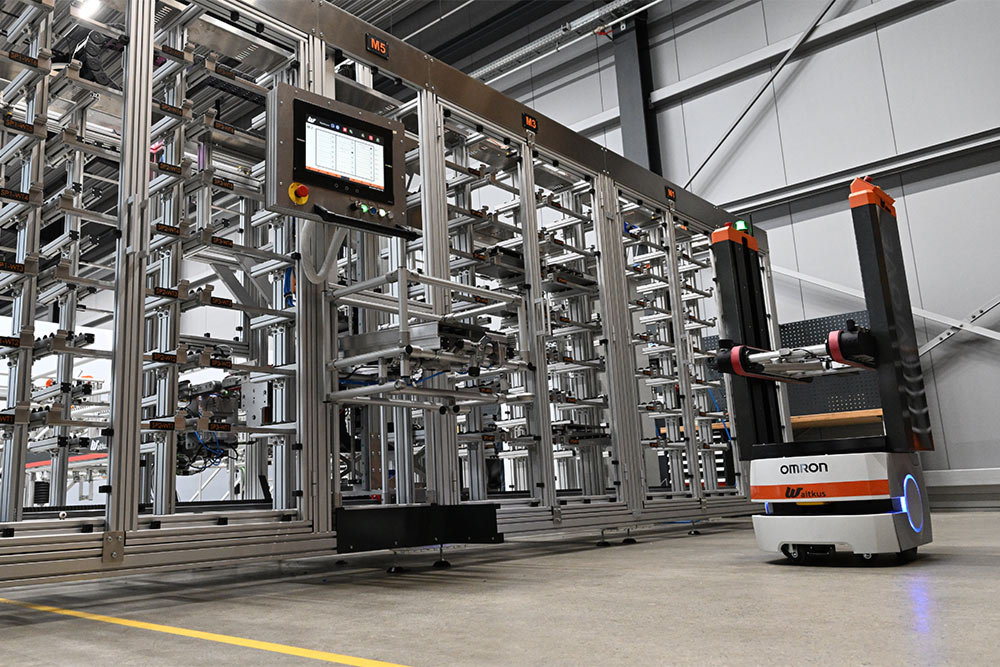
How WAITKUS is automating the flow of materials in production
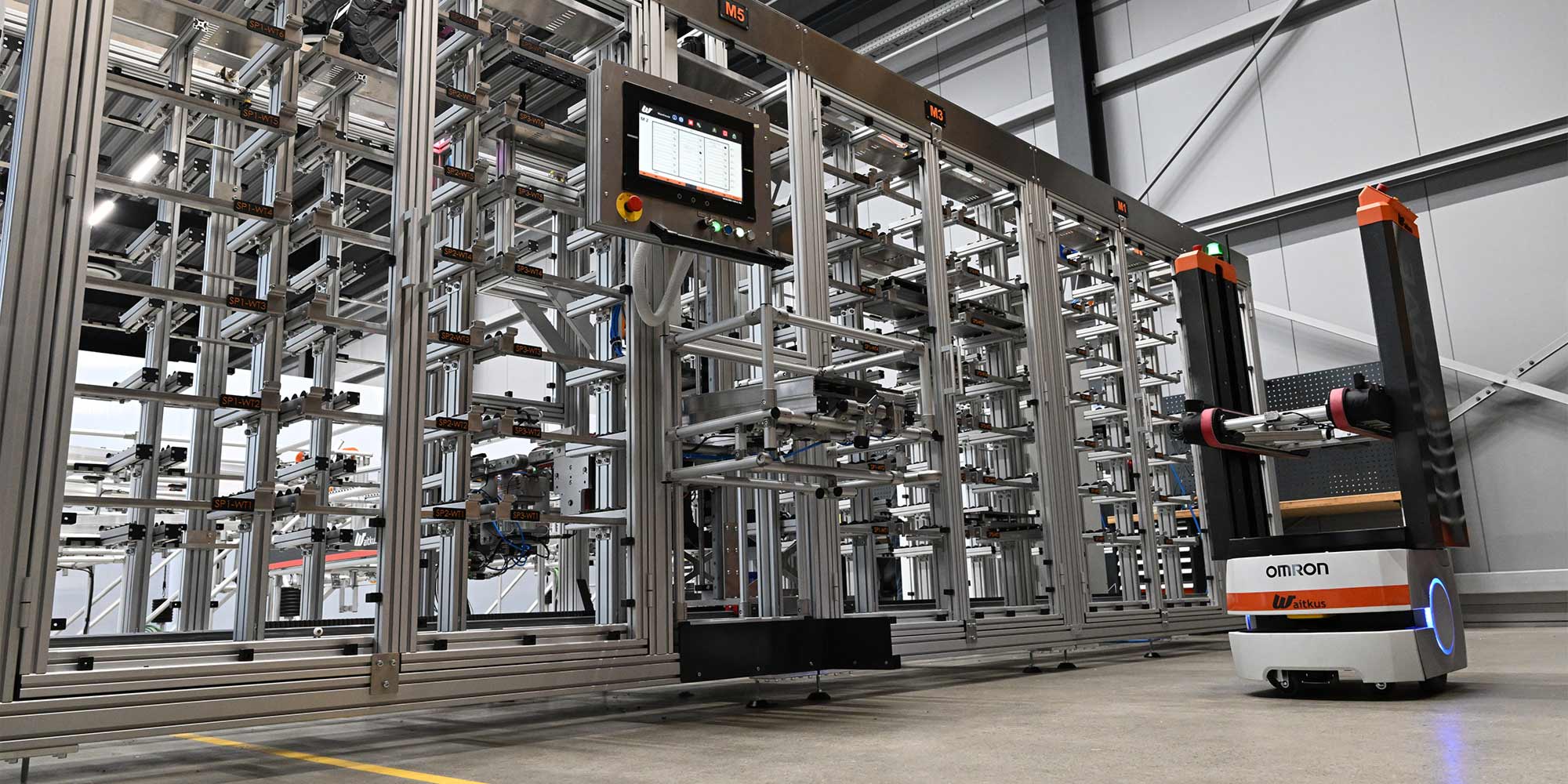
When it comes to material flow automation, two Omron LD90 autonomous mobile robots (AMRs) take centre stage. In combination with the specially developed WAITKUS WeMove superstructures and operating in two shifts, they take care of all transport tasks between the warehouse, assembly work benches, inspection cells and the goods issue department. The AMRs collect materials from the warehouse, head for various Karakuri stations (source and sink/destination stations), supply work benches with materials and transport filled goods carriers to the next station, such as an assembly work bench. The WeMove superstructures dock onto the source and sink/destination stations with the utmost precision. The goods carriers are transferred on roller conveyors that harness the force of gravity. Thanks to their variable design, the WeMove superstructures have a vertical reach of up to one metre, meaning they can cope with a variety of transfer heights.
Automating the process of transporting goods means skilled staff can focus exclusively on value-adding work.
“Automating the process of transporting goods means skilled staff can focus exclusively on value-adding work,” explains Waitkus. Assembling components is one example of such work. On completion of the assembly process, the AMRs collect the relevant goods carrier at the Karakuri/LCA station and take it to the casting and curing line. The goods carrier is then returned to the warehouse on a conveyor belt and stored for a defined amount of time. At the end of this storage period, an AMR transports the goods carrier to the inspection station or the goods issue department. This fully automated flow of goods is controlled by the fleet management system.
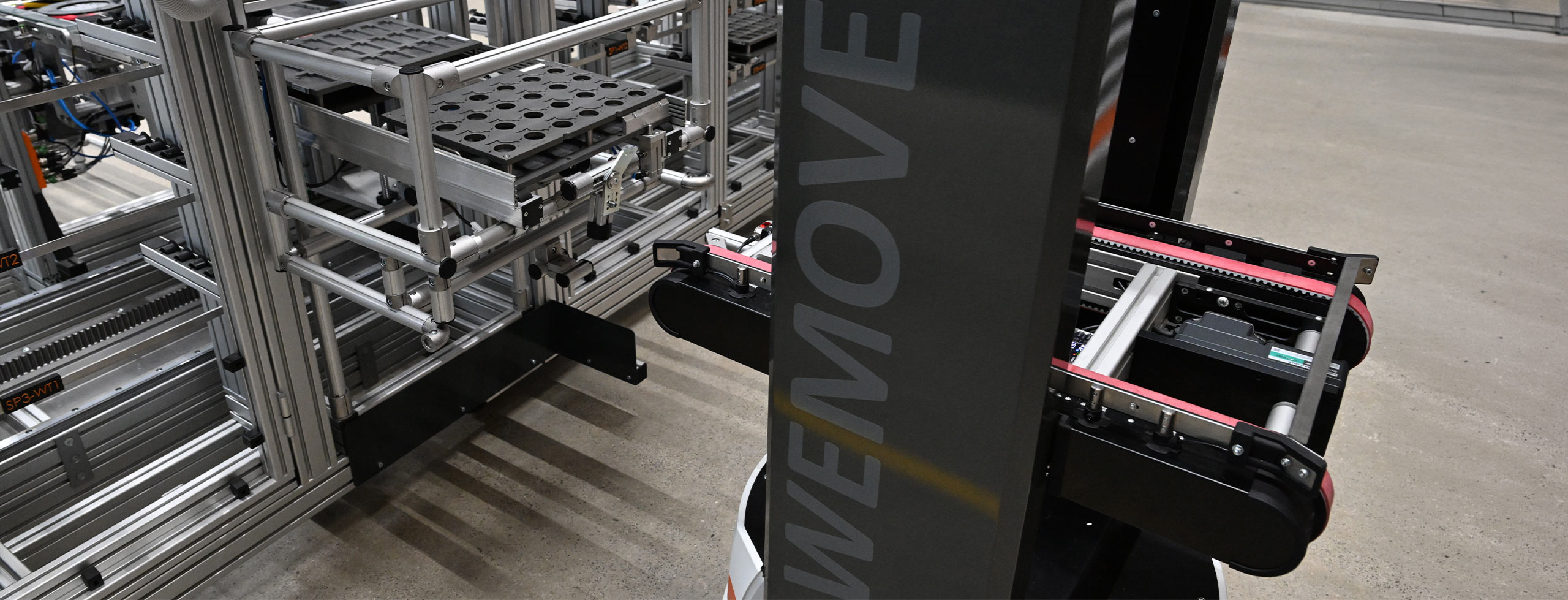
LCIA – a combination of gravity, mechanics and digital interfaces
The Karakuri/LCA stations act as source and sink/destination stations, meaning the majority of movements harness the force of gravity. To ensure a fully automated flow of goods, however, the systems need to communicate with each other to synchronise both storage times and the collection and processing of goods carriers. “Completely eliminating electronic components is impossible, because you still need communication points somewhere so you can talk to the systems. That’s why we call it low-cost intelligent automation,” explains Waitkus.
Sensors on the Karakuri/LCA stations tell the fleet management system when a particular station is full. The way this system controls the AMRs ensures no goods carriers are transported to a full station. Smart solutions are used in the warehouse, too. When goods carriers are placed in storage, they are scanned so that all the relevant information about the type of components and the storage time is passed on. At the end of the storage period, the fleet management system automatically sends an AMR to collect the carrier.
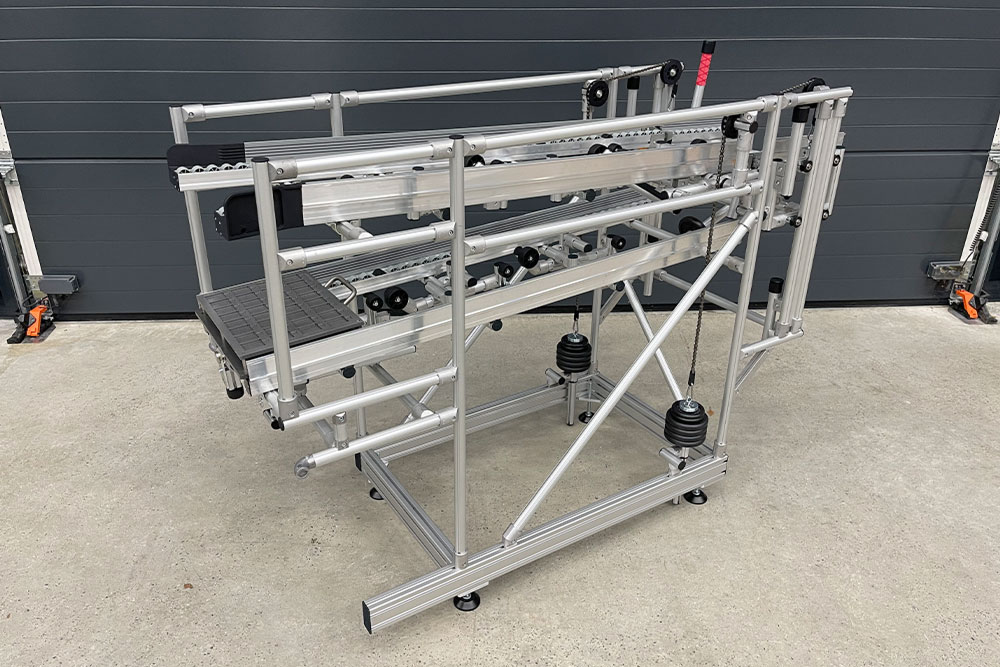
An automated flow of goods based on item profile technology
The project is largely based on components from the item Building Kit System and the item Lean Production Building Kit System. For example, the warehouse’s base frame and storage structure are made from Line 8 and Line D30 profiles. The goods carriers are stored here in a compact arrangement and supplied on gravity-powered roller conveyors, also from the item portfolio. The Karakuri/LCA stations, too, are based on Line D30 profiles. Lightweight, robust profiles make up the base frame, while roller conveyors and mechanical transfer gates ensure the reliable delivery of individual goods carriers.
We use item solutions because of the profile technology’s consistently high quality – it’s reliable, sturdy and flexible, too.
The WeMove superstructures specially developed by WAITKUS have a robust base frame made from Line 8 aluminium profiles. “We use item solutions because of the profile technology’s consistently high quality – it’s reliable, sturdy and flexible, too. These exact same features are vital when mechanics and automation need to intermesh seamlessly,” emphasises Waitkus.
Do you want to keep up to date on the various ways that item products are being put to use? Then we have just what you’re looking for! Simply subscribe to the item blog by completing the box at the top right.