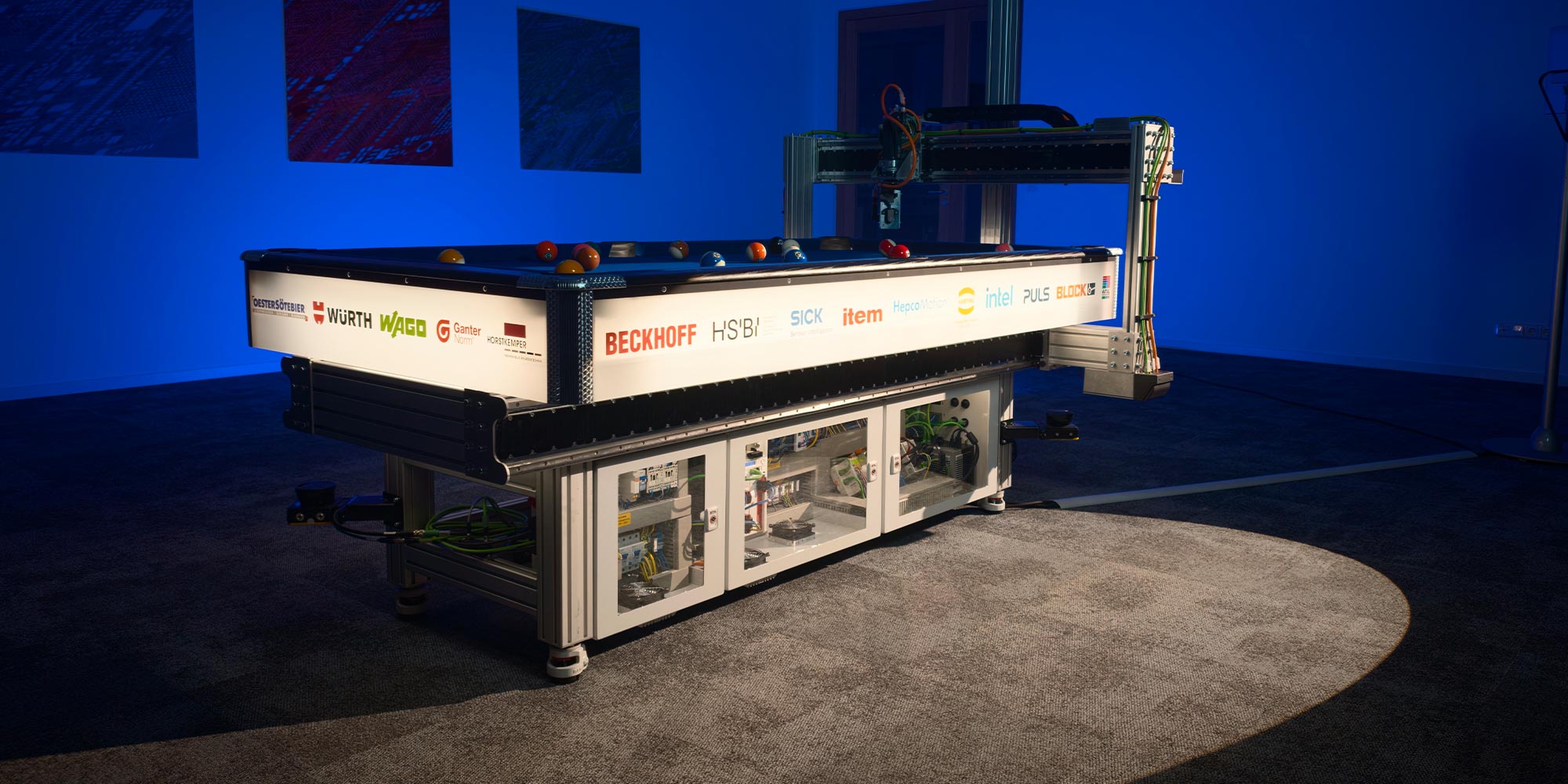

Four students have developed a fully automated billiard robot in a project that is as innovative as it is spectacular.
Billiards is all about precision, timing and the right angle. Few sports require such high levels of concentration and spatial awareness. Virtuoso shots are even more amazing when it’s not a human who is hitting the billiard balls with such expertise, but instead an intelligent robot system that recognises the balls on the table, calculates shots and executes them all by itself.
That’s exactly what a four-strong team at the Gütersloh campus of Hochschule Bielefeld University of Applied Sciences and Arts (HSBI) has achieved. All students on the work-integrated Bachelor programme in Mechatronics and Automation, they have created the fully automated B.R.E.A.K. billiard robot in a project spanning two semesters. B.R.E.A.K. is the acronym for the robot’s full name in German, which translates as “billiard robot for the autonomous execution of shots”. This robot system can play independently against human opponents. The modular profile technology of our item Building Kit System was used to build the base frame and other elements.
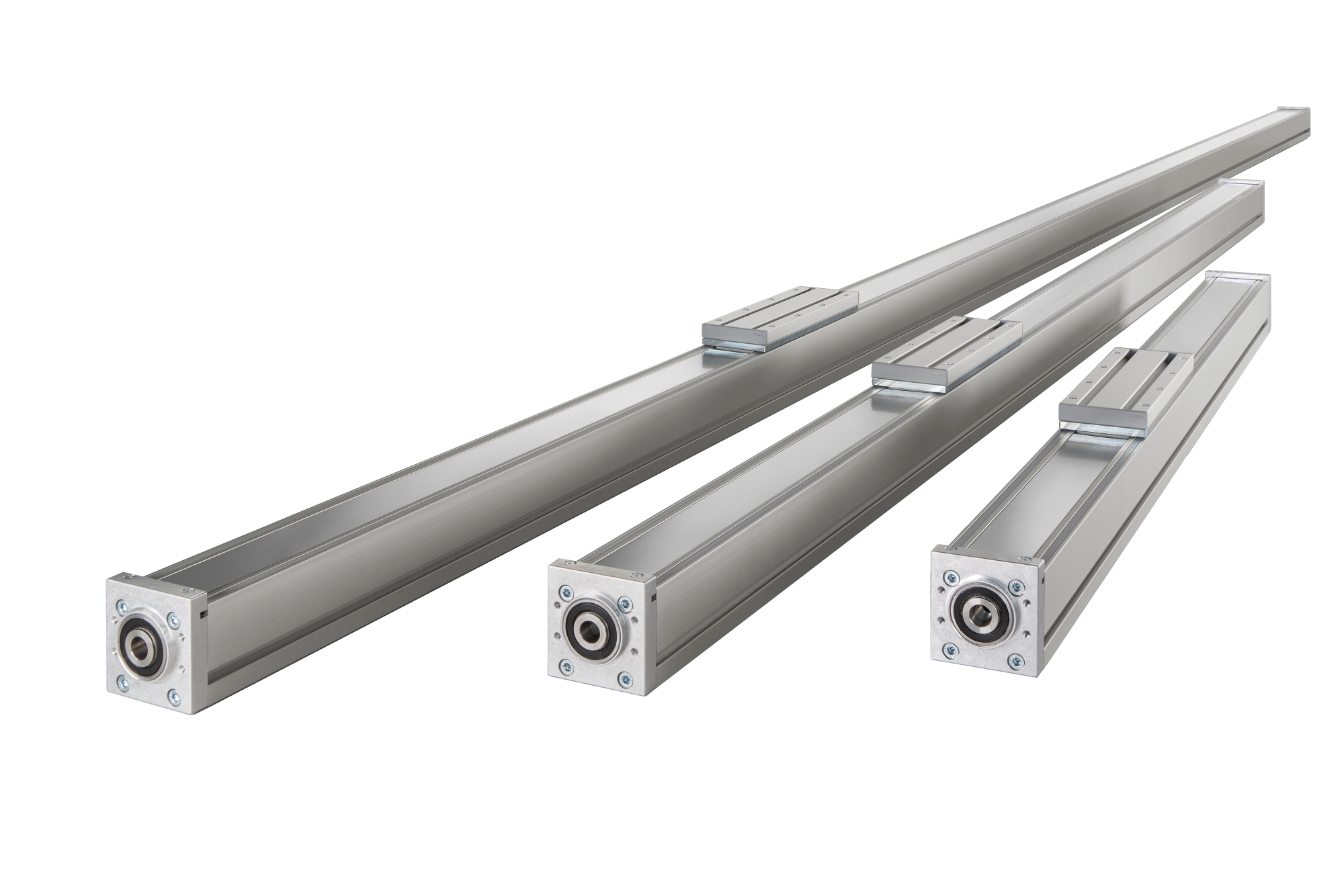
System for maximum versatility
Opt for the original modular design solution and benefit from the diversity of the item Building Kit System. The end-to-end compatibility of all components gives your creativity a whole new dimension.
From dream to reality – how B.R.E.A.K. came about
The fact that all team members are students on the work-integrated programme means they are continuously switching between theory (at the university) and practice (at a partner company). Ben Donkervoort has finally been able to realise a long-cherished vision. “Even before I started the degree programme, I had the idea of building a billiard robot one day,” he reveals. Donkervoort became the team leader and took charge of the management and design engineering side of things. Together with Antoine Angert (software and image recognition), Michael Wilhelmstroop (electronics and design engineering) and Niklas Hils (electronics and software), he turned the idea into a concrete project as part of the study programme. The task during the sixth semester was to prepare the specification documents, and the project itself was carried out during the seventh semester.
The team built an initial prototype in the space of a week to prove the project was feasible.
It was by no means certain that B.R.E.A.K. would even get the go-ahead. The students’ supervisor originally thought it was too ambitious. That led the team to build an initial prototype in the space of a week to prove the project was feasible. The proof of concept also produced some initial findings regarding the necessary rigidity of the frame and guides. The impact force that had been calculated was verified, too. In addition to this, publicly available training data was used to try out identifying the billiard balls and recognising their position – with successful results. This high level of commitment won over the professor, and the project finally got the green light.
How the billiard robot works
“The robot starts by using a camera that is attached to the top of the structure along with the lighting to recognise the position of the balls,” says the project leader, explaining the basic principle. During this process, the monochrome camera generates a coloured image with flash sequences in blue, green and orange. A machine learning model then recognises and classifies the balls. Any lens distortion is corrected automatically. The next step is for a software program to calculate the optimum shot based on a physics simulation and the rules of the game. Playing off the cushion isn’t possible just yet.
We can precisely define the force, i.e. how hard the robot should play the shot.
A mechanical gantry structure that moves over the billiard table rather like a 3D printer and lines up the shot angle is responsible for shot execution. A pivot-mounted ball striker driven by a planetary gear makes the actual contact with the ball. “We can precisely define the force, i.e. how hard the robot should play the shot,” explains Wilhelmstroop. Linear motors ensure precise positioning.
High technical demands and challenging requirements
The team used the Python programming language to develop the ball recognition and shot planning aspects. TwinCAT automation software controls the whole process to turn the calculated shot into a smooth movement. Two safety laser scanners are used to ensure the necessary protection when the robot is playing its shots. The billiard robot stops operating as soon as anyone comes within a 1.5-metre radius of the table, with LEDs indicating the safety status. In addition to this, the area below the table benefits from creep zone protection.
In principle, it should be possible to transport the table and have four people carry it, including through doors, into lifts and into a van.
“In principle, it should be possible to transport the billiard table, complete with robot, and have four people carry it, including through doors, into lifts and into a van. Amongst other things, the team has integrated two electronic spirit levels so the table can be reliably realigned each time it’s set up again. Despite the challenging requirements, the team has achieved its goal of the robot potting 80 percent of balls.
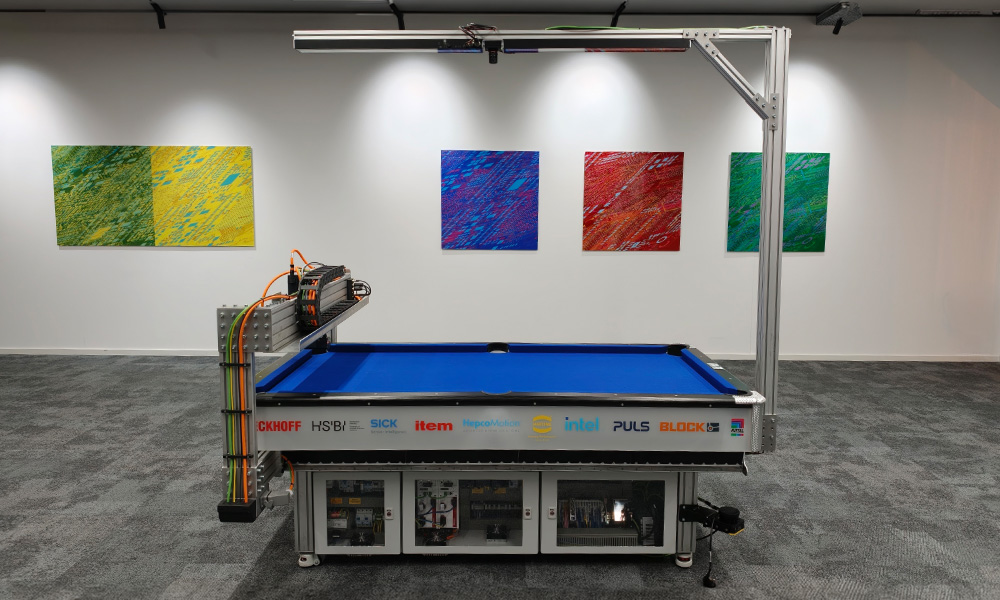
Modular billiard robot design based on item profile technology
In view of the requirements, being able to make changes quickly was vital. That’s another reason why the base frame, gantry structure and camera arm are made from item profiles. “Thanks to the item Building Kit System, it’s exceptionally easy for us to make changes. What’s more, project groups using the billiard robot after us will also easily be able to change things down the line,” explains Donkervoort. “The modular design gives us maximum flexibility, can be assembled and dismantled quickly and minimises the weight,” he adds. A steel frame, on the other hand, would have been too heavy and inflexible.
The modular item design gives us maximum flexibility, can be assembled and dismantled quickly and minimises the weight.
How useful this modular approach is in practice became evident when the drive concept was changed in the middle of the project. The original plan was to use a ball screw drive. When a less expensive and functionally superior concept was identified, however, different aluminium profiles were needed. item supplied these straight away and they proved easy to integrate. “We always got a very quick response from item. All their support really helped us on our way,” says Donkervoort, summing up the experience of working with us.
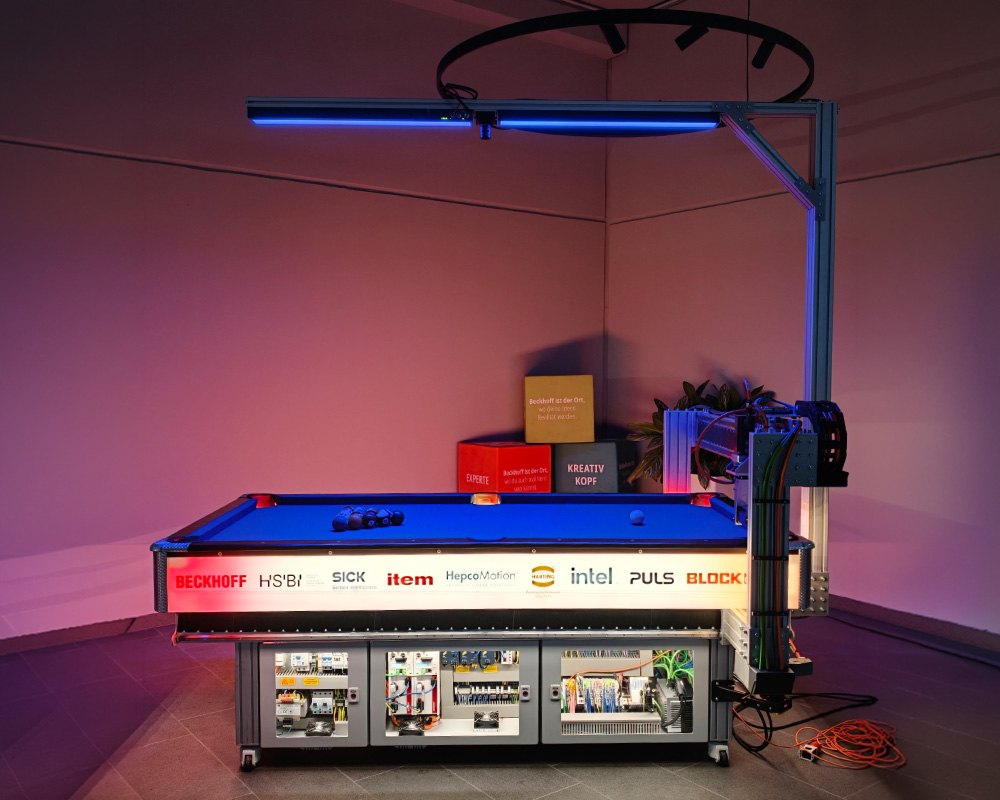
Cue the next step
B.R.E.A.K. is part of a true tradition at the Gütersloh campus. The “Caipi” cocktail-making machine and the “BullsEye” automatic dartboard were also made using our profile technology and are continuously being enhanced by subsequent groups. The plan is for B.R.E.A.K. to follow suit. Thanks to our T-Slot Nuts, new modules can be added as and when required. In the long-term, it is envisaged that the robot will also be able to play 9-ball and other cue-sport variants.
Do you want to keep up to date on the various ways that item products are being put to use? Then we have just what you’re looking for! Simply subscribe to the item blog by completing the box at the top right.