

Precise positioning without external/extra sensor technology. How does that work? And what does NEMA actually mean?
In this beginner-friendly, clearly structured blog post about stepper motors, you’ll find answers to these questions and many more besides. Read on to learn the basics, to find out about the benefits and typical areas of application, and to discover the Integrated Motor ST NEMA24 from item.
Stepper motors at a glance:
- Functional principle: Stepper motors convert electrical pulses into precise mechanical steps. Positioning without a sensor (open-loop control) is possible. However, Integrated Motor ST NEMA24 from item features closed-loop control for better regulation.
- Features: High holding torque, brushless design, typical step angle 1.8°. Both unipolar and bipolar variants are available.
- Areas of application: Ideal for precise, repeat-accurate movements in 3D printers, CNC machines, scanners, robots, medical technology and packaging machines.
- Benefits: High precision, simple control, low costs, robust design, excellent start/stop behaviour and powerful at low speeds.
- Comparison: Synchronous servomotors for highly dynamic movements; stepper motors for economical, precise positioning in low speed ranges.
- NEMA 24: This defines the flange size (60 × 60 mm); it is an established standard, not a quality or performance feature.
- Integrated Motor ST NEMA24 from item: Solution with integrated control system, easy configuration, gearless design and attractive overall cost structure. The alternative is to assemble a complete solution comprising a motor, an encoder, a rotary encoder, a PLC, a braking resistor and all the necessary cabling.
Explanation – what is a stepper motor?
A stepper motor is a brushless electric motor that is used to convert electric pulses into precise individual mechanical steps (angular movements). It is a kind of motor used primarily for control purposes that can carry out positioning tasks without requiring a sensor. It is also known as a pulse motor.
The rotor turns by an exact fixed angular increment with each pulse, so a stepper motor ensures precise positioning and speed control without requiring a feedback sensor (open-loop control).
With a stepper motor, positioning tasks can be carried out at low cost and with simple control. Stepper motors are therefore being used increasingly in solutions that call for relatively simple, economical positioning. Karakuri/low-cost automation applications are one example.
Features and how stepper motors work
- Step-by-step rotary movements: The rotor does not rotate continuously; instead, it moves in small, individual steps. Normally, 200 steps per revolution can be individually controlled, which means each step is 1.8 degrees.
- No sensor necessary: The exact position of the rotor is defined by the number of pulses transmitted.
- High holding torque: When it is at rest, the stepper motor holds its position.
- Brushless design: This means a long service life, low maintenance requirements and no friction losses (energy-efficient operation).
- Distinction between unipolar and bipolar models: A distinction is made between unipolar stepper motors, which have simpler control and five or six connectors, and bipolar motors, which have four connectors and produce a higher torque.
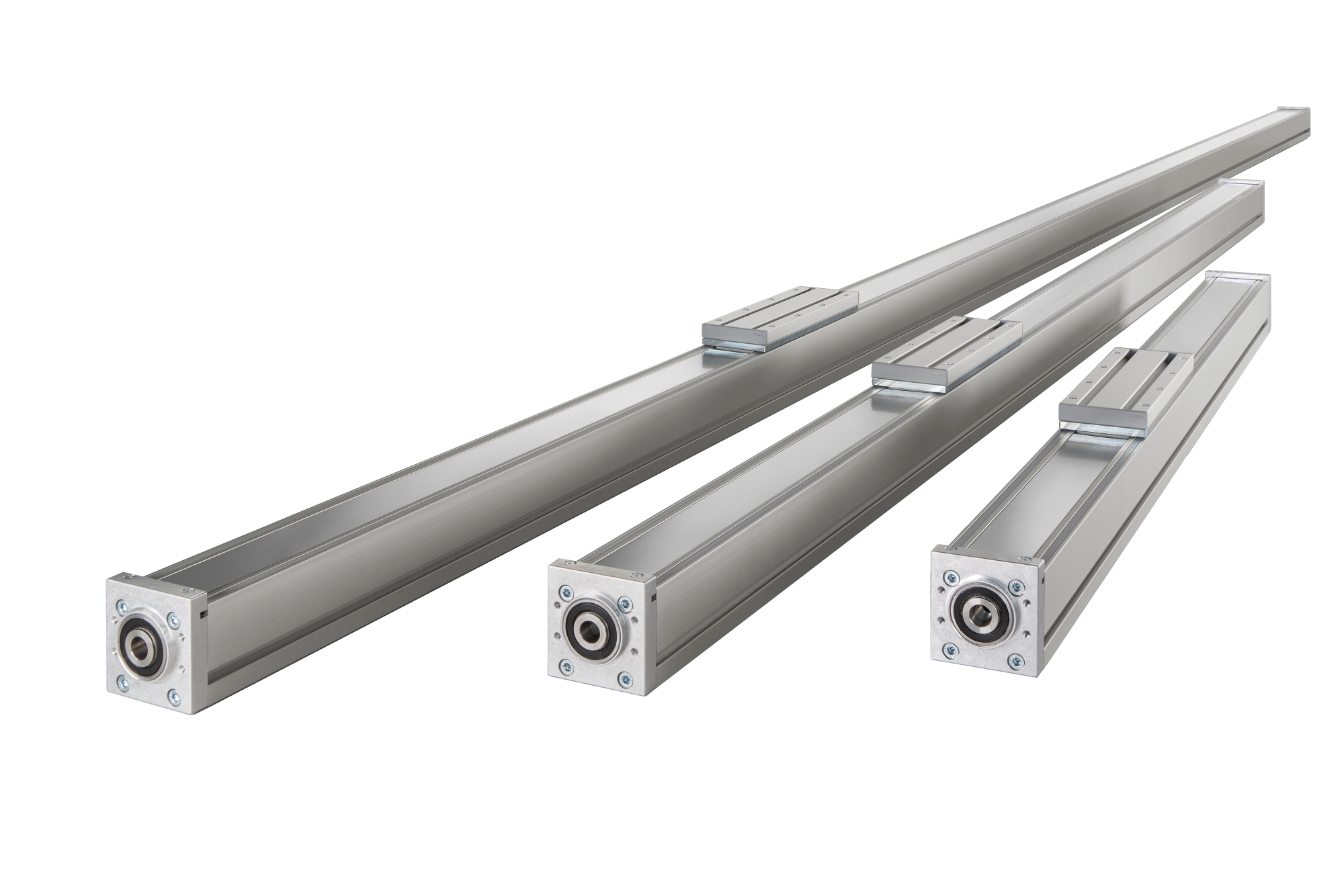
item linear technology at a glance
Discover our entire range of linear technology in the item Online Shop – ready-to-install linear units and linear guides, guide and drive components, motors, gearboxes and much more besides.
How does a stepper motor work (in simple terms)?
A stepper motor converts electric pulses into small rotary movements (steps). It consists of a stationary outer part (the stator) with electromagnets and a moving part at the centre (the rotor). The rotor is often magnetic. Each pulse turns the rotor by a set angle, similar to the way the second hand of a clock works.
The true strength of stepper motors lies in their simple, low-cost control and their ability to maintain a high torque, even when at rest. They are therefore well suited to economical automation solutions.
How is a stepper motor controlled?
Stepper motors are controlled by a controller (usually a microcontroller) and a power driver that convert the digital pulses into precise rotary movements. The driver supplies the necessary coil current, while the step number and frequency determine the position, speed and direction. There are three common stepping modes – full-step, half-step and micro-step.
What can you do with a stepper motor?
Thanks to its precise, step-by-step rotation, a stepper motor makes positioning possible without position feedback. Stepper motors are used in a wide variety of applications where precise positioning and control are crucial. For instance, they are used to move components accurately in the following equipment:
- 3D printers
- CNC machines
- Scanners
- Robots
Another typical area of application is repeat-accurate tasks without complex feedback. Examples of such applications can be found in the following sectors:
- Medical technology (infusion pumps, analysis equipment)
- Automation technology (packaging machines, conveyor belts)
- Automotive technology (heating and climate control flaps)
Stepper motors are generally suited to applications that require a simple, economical drive with high torque at low speeds.
What are the benefits of stepper motors?
Stepper motors offer precise positioning and high repeat accuracy without an encoder, because the movement takes place in small increments. They are therefore ideal for 3D printers and CNC machines. If they do incorporate an encoder, however, the level of precision is even higher. Integrated Motor ST NEMA24 from item is a very good example of this.
Here are some of the key benefits of stepper motors:
- High precision: They ensure precise positioning and repeat accuracy.
- No encoder required: The position is controlled via the counted steps (open-loop control). This cuts down on costs.
- High holding torque: Stepper motors offer a high torque at rest to ensure that positions are maintained securely.
- Easy control: Stepper motors are controlled via digital pulses from microcontrollers.
- Reliability and low maintenance requirements: Thanks to their brushless design, stepper motors are robust and require little maintenance.
- Excellent start/stop behaviour: Stepper motors are ideal for applications involving sudden changes of direction or frequent stopping and starting.
- High torque at low speeds: Stepper motors really come into their own at low speeds.
What’s the difference between a synchronous servomotor and a stepper motor?
Synchronous servomotors are better for fast, dynamic tasks with feedback (closed-loop control). They also feature a higher load-to-size ratio and better energy efficiency. Stepper motors, on the other hand, are ideal for precise, constant movements without feedback (open-loop control). They are also more efficient and provide higher torques at low speeds. Synchronous servomotors accelerate faster, but are more expensive.
Which type of motor is best depends on the application, budget and performance requirements:
- Synchronous servomotors for high dynamics (e.g. six-axis robots)
- Stepper motors for simple positioning (e.g. 3D printers)
What does NEMA stand for?
NEMA is an abbreviation that stands for the “National Electrical Manufacturers Association”, which is the largest trade association of electrical equipment manufacturers in the USA. NEMA defines standards for motors, electrical enclosures and plug connections.
What is a NEMA 24 stepper motor?
A NEMA 24 stepper motor is a stepper motor with a 2.4 x 2.4 inch or 60 x 60 mm flange plate.

What is Integrated Motor ST NEMA24 from item?
Integrated Motor ST NEMA24 from item combines a compact design with high torque and precise control of the motor shaft. It has an integrated control system and is easy to install. No higher-level PLC is required. What’s more, you don’t need any specialist know-how to be able to configure it quickly, easily and safely. No gearbox is required and, when considering the overall system (motor, controller, cabling, etc.), it is an economical solution.
How do you program Integrated Motor ST NEMA24 from item?
The free item MotionSoftStepper software is used to program Integrated Motor ST NEMA24 from item. All it takes is a few clicks to create a complete sequence control system for your application. Thanks to carefully conceived operating modes, easily adaptable modules can be used as a basis for your own specific project.
What is an ideal area of application for Integrated Motor ST NEMA24 from item?
The benefits outlined above, combined with the robust operation and compact design of Integrated Motor ST NEMA24 from item, make it ideal for Karakuri/low-cost automation applications.
It is therefore perfect for automating non-value-adding tasks, such as lifting containers and small load carriers, and for taking over activities that would be ergonomically problematic for staff. This leaves workers free to focus on productive activities.
Dividing tasks into those that add value (production) and those that don’t (transportation) and conducting these in parallel can boost productivity and massively reduce throughput time. This is the ideal way to implement lean production under ergonomic conditions.
Other ideal areas of application include positioning mechanisms for sensor and camera systems and also packaging machines, which carry out numerous simple linear movements, such as when folding a carton.
What should you bear in mind when buying a stepper motor?
When it comes to buying a stepper motor, the key criteria to consider are power and torque. To comply with the Low Voltage Directive, operation below 48 V is important. The power determines the size of the motor and the diameter of the shaft, and these aspects also need to be taken into account when selecting the appropriate fixing.
Choose a closed-loop system for greater reliability, and think about the installation environment and the winding design that will best suit the speed of your application.
Where can I buy a NEMA 24 stepper motor?
You can buy Integrated Motor ST NEMA24 in the item Online Shop.
Scope of Supply:
- 1 Integrated Motor ST NEMA24
- 1 quick-start guide
Features:
- Operating voltage: 16 … 52 V DC
- ESD-safe: No
- Weight: m = 1.515 kg
- Nominal power: Pn = 100 W
- Ambient temperature (during operation): +10 °C … +40 °C
- Interfaces: USB, RS485, digital I/Os
- Stall torque of motor: Tstall = 3 Nm
FAQs about stepper motors (NEMA 24)
How do I find the right size of motor for my application?
The crucial factors are the holding torque required, the operating voltage and the shaft diameter. NEMA 24 (60 × 60 mm flange) is a common standard for mid-size industrial applications. Smaller motors such as NEMA 17 are suited to lighter loads, while larger motors such as NEMA 34 are suitable for tougher requirements. It is important to note that stepper motors lose torque as their speed increases. The torque curve should match the application.
Can I combine the item stepper motor directly with an item Linear Unit?
Yes. By using a NEMA-24-compatible Drive Set, you can combine Integrated Motor ST NEMA24 from item with item Linear Units to create a plug-and-play solution.
Enjoy the benefits of the Motor ST NEMA24 StarterKit:
- This plug-and-play solution safeguards the electrical connection of Integrated Motor ST NEMA24 and its controller.
- Safely encased components can be fastened to profile grooves or stowed in a cable conduit.
- The components don’t need a separate enclosure and don’t have to be wired up by an electrician.
- Thanks to DC-DC Converter 48V/24V, the power supply unit, which is also included, is all you need to start using the motor.
- An enable switch is included for starting up and shutting down the motor safely.
What operating modes are there for stepper motors?
The most common modes are full-step, half-step and micro-step. Full-step mode provides maximum torque but lower resolution. Half-step mode doubles the number of steps, so the motor runs more smoothly. Micro-step mode allows for very fine positioning and reduces vibrations, but decreases incremental torque slightly. Micro-step mode is normally used for high-precision applications.
What impact does ambient temperature have on a stepper motor?
Stepper motors generate heat during operation because the windings are continuously carrying current. Make sure you have adequate cooling in place and take note of the ambient temperature specified by the manufacturer. Integrated Motor ST NEMA24 from item is designed for operation in an ambient temperature of up to 40 °C. Torque may decrease in higher temperatures, while lubricants in bearings or guides may be adversely affected in very low temperatures.